
April 18, 2026
One seat plan — single source of truth on a chaotic floor
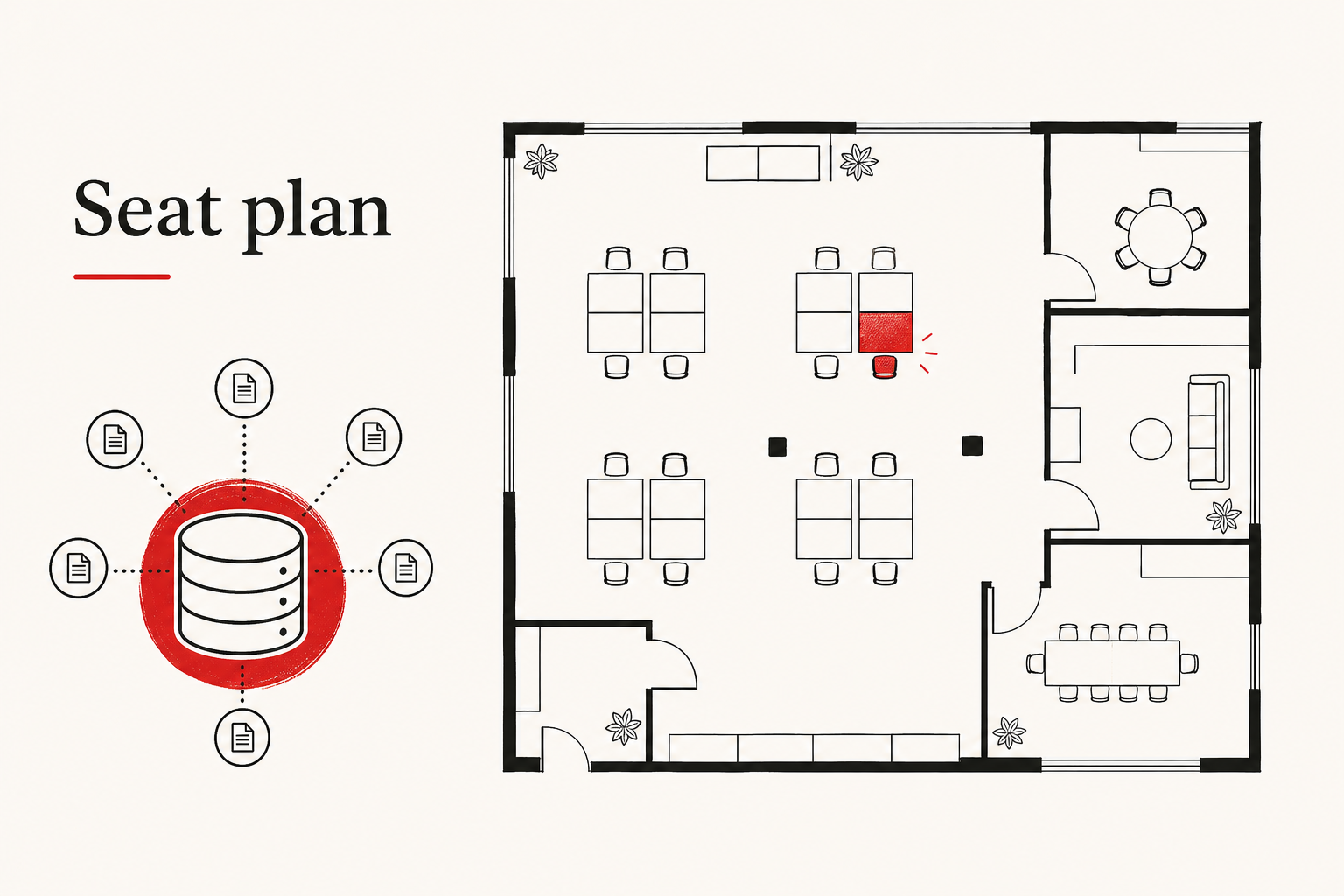
I rarely start seating work with “add another spreadsheet column.”
I start with:
- What’s the purpose — one floor everyone can trust?
- How does this improve ops and management when the office keeps changing?
- What do we already track that still leaves every department with its own copy?
Startups are normally chaotic. People move. Teams grow. Someone updates “their” seat plan and three other copies go stale. Ops and management each keep a version. Over time everyone gets lost — not because nobody cares, but because there is no single source of truth.
Context
The problem I was solving
Multiple department copies of the seat plan. Change a seat in one file, and the others lie. Capacity planning turns into a crisis of questions:
- How many workstations do we have?
- How many are vacant?
- Who sits here — and which assets are on that desk?
A text location on an inventory item does not fix that. Neither does a flat workstation list next to a private Excel layout.
What we already had
I did not start from a blank facilities product. The inventory / asset system already held:
- Items — including codes / serials and optional text location
- Workstations — desks as system records
- Assignments — people and desk assets
- Zones — enough structure to group desks by department or area
That was enough raw material. What we lacked was one live floor that ops and management both used — not another file to fork.
How I came up with the solution
The question was not “build a prettier map for IT only.” It was: if every department updates its own seat plan, how do we stop records from going outdated?
what we already had
  items (+ codes / serials)
  workstations
  assignments / desk assets
  zones
        │
        ▼
what still failed
  many seat-plan copies
  capacity by guess
  “where is this asset?” across files
        │
        ▼
seat plan (same system, different job)
  one map for ops + management
  zone filters + occupancy
  search by person or asset code
So the solution was to reuse the operational store we already ran for inventory, and put an interactive seat plan on top of it. Update once; every department benefits. No second system of record — and no pile of private copies.
What I proposed
One record, many beneficiaries
Only one seat plan needs updating. Ops and management look at the same map. Departments stop maintaining private copies that drift the moment someone moves.
Capacity without a crisis
At a glance: how many seats exist, how many are open or occupied, and where the empty ones are — including by zone / department. Filter a zone, then see what is available for that area instead of scrolling three outdated sheets.
People and assets on the same floor
Open a desk: who is assigned, what assets sit there. Search by asset code or serial when the question is “where is this machine?” — not “which copy of the plan is newest?”
Occupancy in plain language
Open, available, onboarding, carry-over (person has items but desk setup is incomplete), occupied — enough status to plan seats without inventing a second inventory.
Together: one source of truth says what the floor is, zone filters say what this department can use, asset search says where this machine sits. The map stays useful because it sits on assignments and items we already maintained in day-to-day IT work.
The condition
The map only stays a single source of truth if the operational chain stays current:
- Assignments updated when people move
- Desk assets tied to the right workstation
- Zones still match how departments actually sit
Stale assignments make a confident-looking map that is wrong. The product will not invent a move nobody recorded.
Limits I stay honest about
- This does not remove chaos from a startup — it removes forked seat plans as a source of chaos.
- I did not invent a parallel inventory — the map sits on the same workstation and asset data.
- Layout wiring for the map is a one-time / occasional engineering concern — not the day-to-day story for ops and management.
- No dashboard vanity — if a view does not change capacity, seating, or “where is this asset?” decisions, it does not earn a seat.
What “done” means
Not “the map page loads.”
- Ops and management use one seat plan — not competing copies
- Capacity answers are readable: total seats, vacant seats, by zone when needed
- You can find a person or an asset (by code / serial) on the floor without hunting files
- A seating change updates one place; other teams stop inheriting yesterday’s layout
If those hold, we turned a chaotic pile of department seat plans into a single source of truth — a smarter use of inventory tools we already had.